Chrysler Airflow and the Art Deco idea of motion
Explore Chrysler Airflow design, the Major Bowes car and its disputed date. Learn which details to compare and how to separate history from restoration claims.
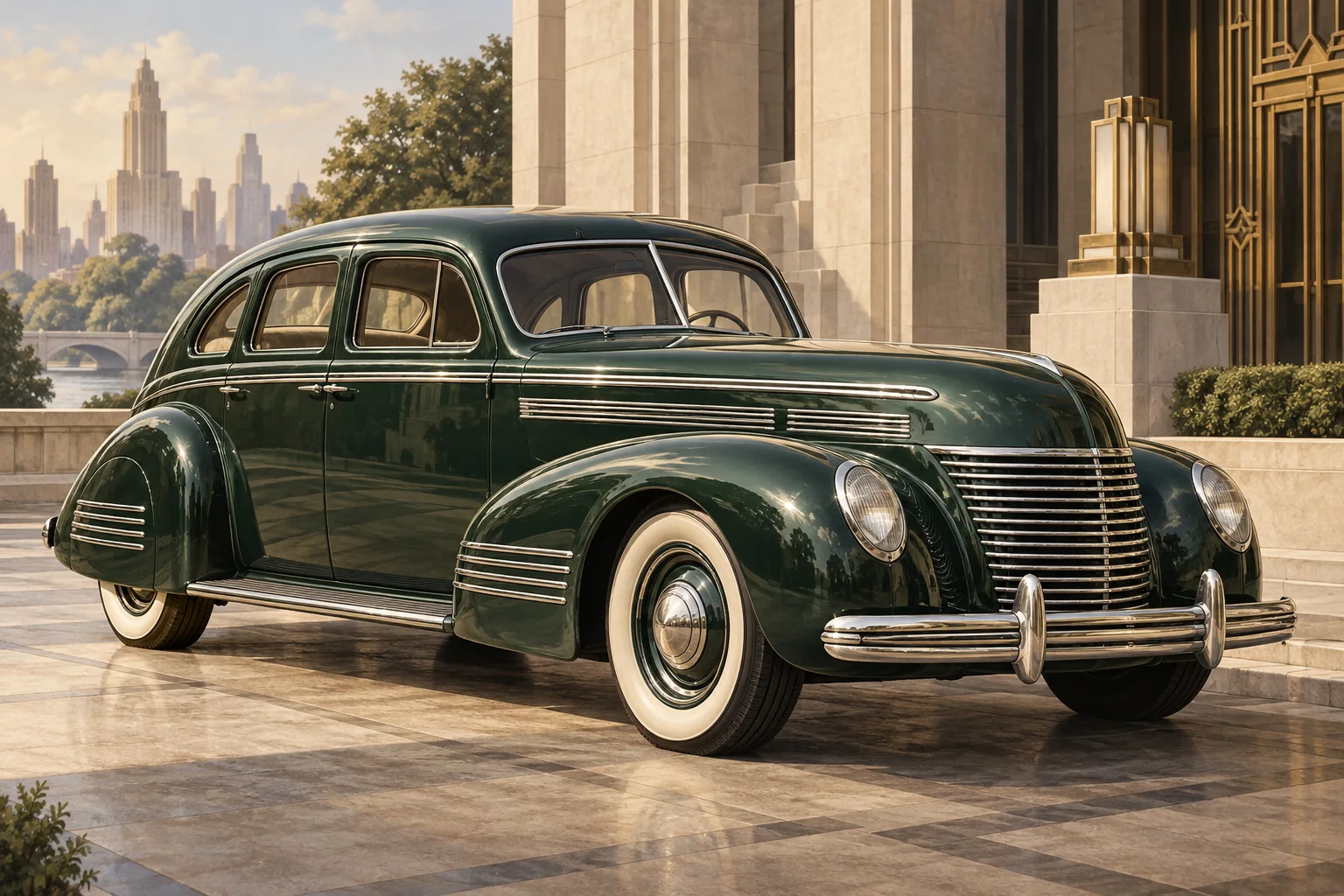
The Chrysler Airflow brings the Art Deco fascination with movement into focus: a continuous body, a rounded front and bright metal details that guide the eye along the car. Its story also rewards careful reading. The Major Bowes custom car is often described online as a 1937 model, while a Walter P. Chrysler Museum history identifies a 1936 Imperial Airflow. Start with that distinction. This guide explains the design, the documentary disagreement and a practical way to study streamlined objects without mistaking an attractive headline for a complete history.
Start with the practical guide ↓
What makes the Chrysler Airflow relevant to Art Deco?
The Airflow belongs in an Art Deco encyclopedia because its form makes modernity visible. A rounded leading edge and an integrated silhouette suggest movement even when the car is parked. That is a different visual effect from the stacked geometry of a cabinet or the sharp facets of a glass vessel. Both can sit within the broader design culture of the period.
Chrysler's own historical timeline dates the Airflow's introduction to 1934. The V&A describes Art Deco as a meeting of inherited decorative traditions and the modern mechanized world. Read those two sources together as context, rather than as proof that every curved car or chrome object is Art Deco.
For a useful comparison, follow the silhouette from front to rear, then examine how separate parts join it. Does the trim reinforce the horizontal line? Do openings break the surface into separate elements or read as part of one composition? These observations describe design. They cannot establish a vehicle's chassis identity or restoration history.
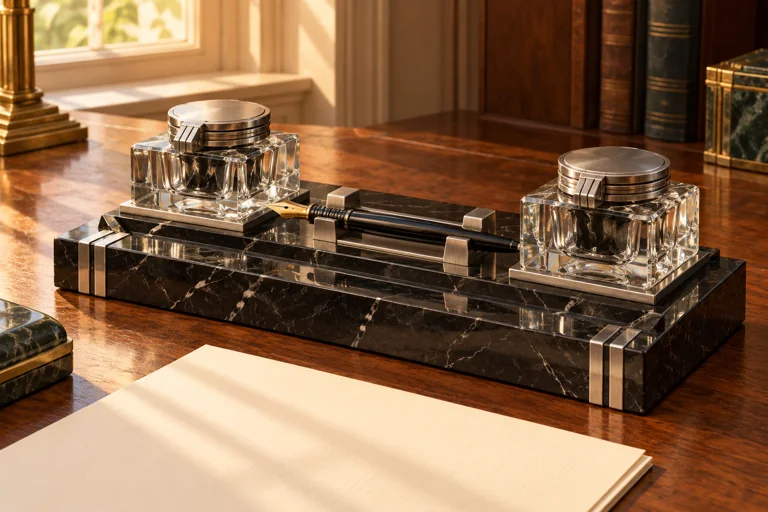
The same exercise works at a smaller scale in Art Deco inkwells and desk sets: compare the relationship between a long base, paired containers and metal fittings. The resemblance is a way of looking, not evidence that one object was designed by the maker of another.
Was the Major Bowes Airflow built in 1936 or 1937?
The sources consulted do not use the same date. The Walter P. Chrysler Museum's history of the Major Bowes radio program describes a custom-made 1936 Chrysler Imperial Airflow, with body modifications by LeBaron and a special console between the front and rear compartments. The specialist history published by Ate Up With Motor discusses CW Custom Imperials updated with 1937 front-end details, including a car for Bowes.
Those accounts may be referring to different stages in a car's manufacture and updating. Without a chassis record and a documented sequence of modifications, it would be premature to settle the discrepancy by repeating “1937” as an uncontested build date. Record the date each source gives and what that date describes.
Build date, model year, later styling updates and restoration date answer four different questions. A car can acquire later trim without becoming a newly manufactured vehicle.
The former search-result title described a masterpiece “reborn.” The sources reviewed here do not establish a recent restoration project matching that claim. This article therefore treats the car's design and documented association with Bowes, rather than presenting an unverified restoration story.
The museum account connects Bowes and Chrysler through radio sponsorship and their personal friendship. That is a historical association supported by the source. It does not establish the present ownership, location, originality or market value of any vehicle advertised today.
Which details should you compare before repeating an attribution?
Begin with identification and only then discuss appearance. A period photograph with a date and caption is more useful than an isolated image labeled “Art Deco car.” For a particular vehicle, ask whether the photograph shows its current condition, an earlier state or a different car of the same series.
| Question | Useful evidence | Insufficient on its own |
|---|---|---|
| Which vehicle is this? | Chassis identification and ownership records | Paint color or a familiar grille |
| Which year is being described? | Build, model-year and modification records | A video headline |
| What was restored? | Dated work reports and before-and-after photographs | A glossy current image |
| What makes the design streamlined? | Views showing the whole outline and trim | The word “aerodynamic” in an advertisement |
For your own notes, make one column for visible features and another for claims that need documentation. “Three horizontal bright strips” is an observation. “Original factory trim” is an attribution. Keeping them separate makes it easier to compare accounts without silently turning a possibility into a fact.
How does streamlined design connect with French decorative objects?
Look for shared choices: repeated lines, carefully balanced masses and contrasts between polished and textured surfaces. These choices can help explain why an automobile, a glass vase and a desk accessory appeal to the same collector. They do not imply a common maker, material or production date.
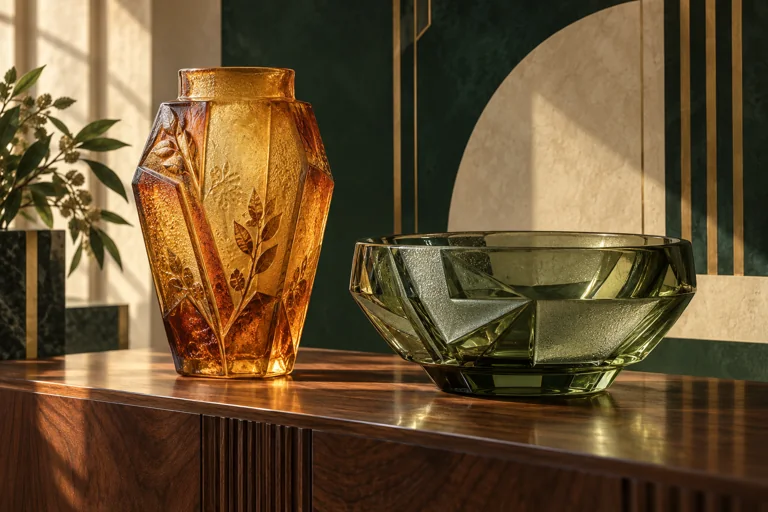
In Daum Nancy glass and its transition toward Art Deco, color, texture and the relation between vessel and decoration are central. A glass surface can organize light in a way that metal trim organizes a car's silhouette. The comparison is most useful when each object has its own source record.
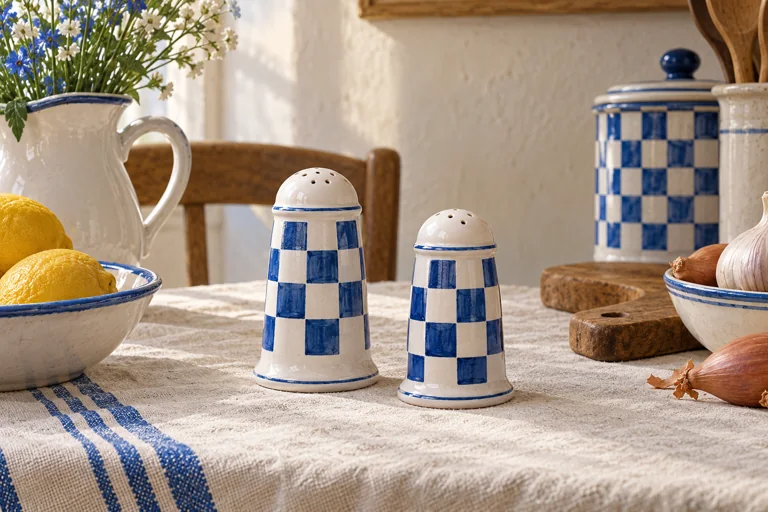
At the kitchen table, Lustucru-associated salt and pepper shakers raise another question: how does commercial identity shape an everyday object? That is a different story from automotive engineering, but both belong to the history of design reaching a wider public.
If your interest is in furnishing a room rather than acquiring a vehicle, explore French vintage homeware at Lo-Cantou. Its collections offer a practical route into domestic objects. This link is not an offer of a Chrysler vehicle or a claim that particular Art Deco pieces are available.
Build a research file that survives an attractive headline
Save the original source title, publisher, URL and access date. Note the exact object or period it describes. A museum history of a radio partnership is valuable context, but it does not substitute for an individual car's conservation record. A specialist model history can explain a design change without proving the history of a car in a sales photograph.
Use at least two views when studying form: a side view for the profile and a three-quarter view for the relationship between front, body and wheel arches. Avoid estimating dimensions from a wide-angle photograph. If a dimension matters, record it from a reliable specification or measurement.
For the larger design context, return to the Art Deco introduction. For acquisition decisions involving a significant historic vehicle, seek a specialist inspection and the supporting records before relying on appearance.
Questions and answers
When was the Chrysler Airflow introduced?
Chrysler dates the Airflow introduction to 1934. That date describes the model’s arrival, rather than the manufacture of every surviving Airflow. When researching an individual car, record its chassis identity, model year and any documented later modifications separately. A familiar body shape does not resolve those questions.
Is the Major Bowes car definitely a 1937 Airflow?
The reviewed accounts differ. A Walter P. Chrysler Museum history calls it a 1936 Imperial Airflow; a specialist model history discusses a Bowes CW with 1937 updates. Describe that disagreement explicitly. Chassis documentation and modification records are needed before assigning one date to every stage of its history.
Is Streamline Moderne the same as Art Deco?
Streamlined forms are often discussed within the wider Art Deco era, but the terms are not interchangeable descriptions of every object. Streamlining emphasizes flowing profiles and the suggestion of motion. Art Deco also includes angular geometry, decorative pattern and contrasting materials. Compare individual designs before attaching either label.
Can I find a Chrysler Airflow through Lo-Cantou?
The Lo-Cantou pages checked for this article concern French vintage homeware and antiques. They do not establish an automobile offering. The connection here is an interest in design and collecting domestic objects. Use the merchant’s current collection pages for homeware and ask directly about availability, condition and shipping.