Art Deco inkwells: what to inspect on a vintage desk set
Explore Art Deco inkwells and desk sets in glass, stone and metal. Check lids, liners, marks and repairs with a practical guide before choosing a vintage piece.
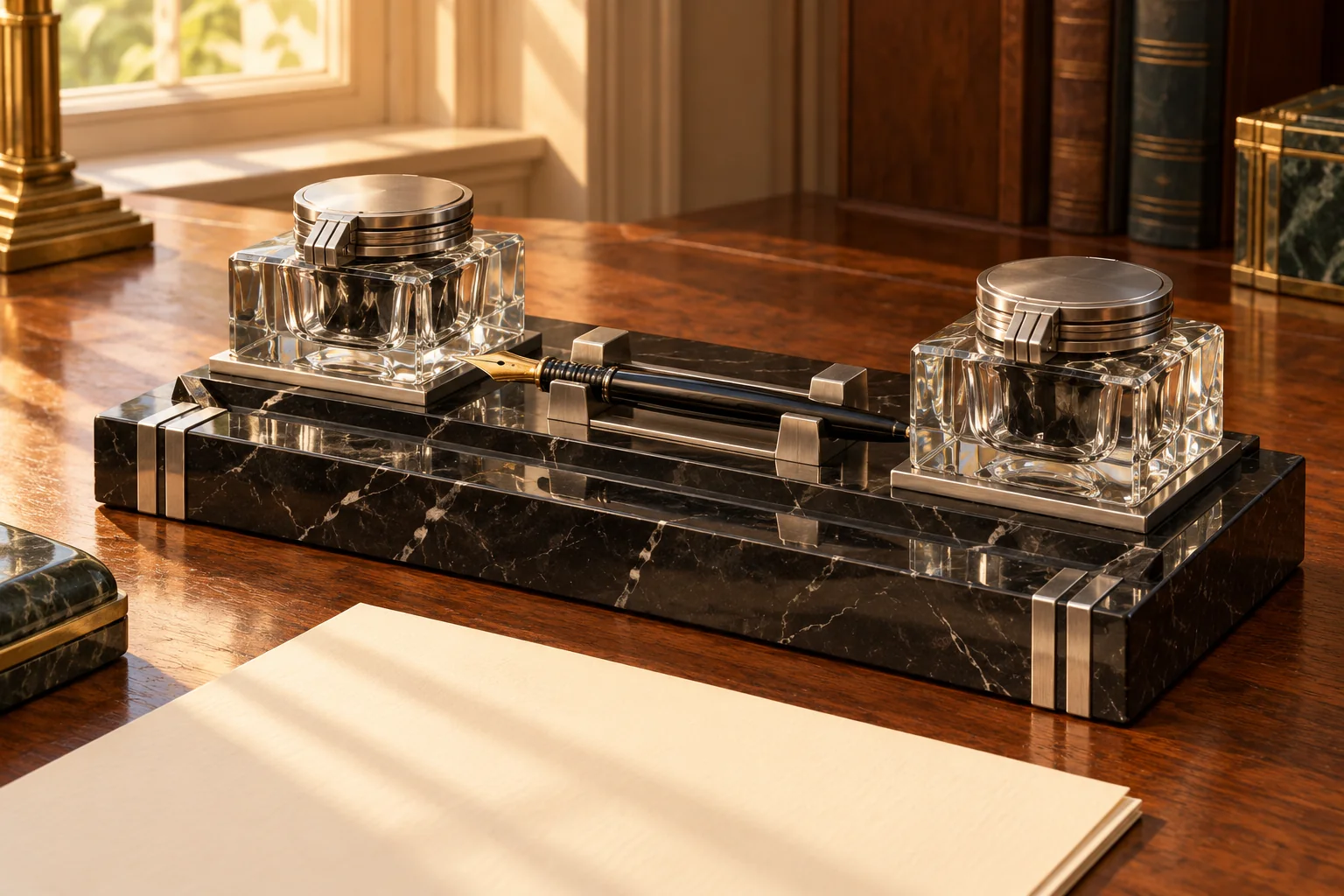
An Art Deco inkwell is more than a small glass container. It may belong to a desk set with a stone base, paired wells, hinged lids and a pen rest, and each component can tell a different story. Before buying, check whether those components belong together and whether the working parts are complete. The French word encrier means inkwell; an inkstand is the larger arrangement supporting one or more wells. This guide gives you a repeatable inspection method for glass, metal and stone, with practical questions for a seller and ideas for display.
Start with the practical guide ↓
Which parts belong to an inkwell or inkstand?
Start by counting the components. A single inkwell holds ink; a desk stand may organize several wells and writing accessories on one base. Depending on the design, a removable inner reservoir may sit inside a decorative outer container. A missing insert can be easy to overlook in a photograph taken with the lid closed.
Open and closed views answer different questions. The closed view shows the overall design. The open view shows the neck, interior, hinge and fit of the cover. Ask for both. A lid that rests attractively on a well may not be the correct size or type for it.
The former search excerpt described two glass wells with metal covers and a central compartment. That is a useful lead for the subject, but it is not a verified description of a piece currently for sale. Its quoted dimensions should not become a standard size for Art Deco desk sets.
Record the full footprint, including pen rests and projecting fittings. Measure the height with covers closed and note the clearance needed to open them. On a narrow shelf, the open position may matter more than the closed dimensions.
How do you distinguish Art Deco style from a confirmed date?
Describe the outline and arrangement first. A rectangular base, paired wells and contrasting dark and transparent materials can suggest an Art Deco composition. Those features also appear in objects made outside a narrow interwar date range. Style is a starting point for research, not a substitute for a dated catalogue or reliable attribution.
A useful counterexample is the Daum inkwell catalogued by Christie's as a vitrified cameo-glass example with cover, circa 1910. Its recorded height is 12.8 cm and its width 10.2 cm. It shows that a Daum inkwell can predate the period usually associated with Art Deco; the maker's name and the object's function do not settle the style.
For more on this distinction, read how to study Daum Nancy glass, marks and techniques. Compare a proposed match across the body, base and cover. Do not use a signature photograph from one object to attribute a different shape.
When a seller proposes a date, ask what supports it: a pattern number, a period advertisement, a collection record or a specialist assessment. If the basis is stylistic, the wording should make that clear. “Art Deco style” and “manufactured in 1930” are different claims.
Where do damage and replacement parts hide?
Examine the places where materials meet. Metal collars can cover the edge of the glass. A well fixed to a stone base may conceal its underside. That does not prove a problem, but it limits what you can establish without inspection. Ask the seller to describe inaccessible areas rather than assuming they are undamaged.
| Component | Look closely at | Ask about |
|---|---|---|
| Glass well | Rim, neck, interior and base | Chips, cracks, staining and missing liner |
| Cover and hinge | Alignment, movement and attachment | Repairs, replacements and loose pins |
| Metal fitting | Edges, finish and attachment points | Plating wear and later refinishing |
| Stone base | Corners, underside and feet | Filled chips, cracks and replaced pads |
| Complete set | Matching proportions and placement | Whether components were assembled later |
Request a photograph of the underside even when the base looks plain. It may show fixing arrangements, marks or repairs that are invisible from above. Ask whether the wells detach; do not force a component loose to investigate it.
For a paired set, compare the wells' height, color, rim finish and lid fit. Small differences can reflect manufacture or wear, while larger differences may prompt questions about replacement. Neither difference nor perfect symmetry is sufficient by itself to prove originality.
Should an old inkwell be used for ink or kept for display?
Decide the intended use before choosing the object. A decorative collector may accept an absent liner if it is disclosed. Someone hoping to use the well needs a sound reservoir and a design that can be filled and cleaned without damaging vulnerable surfaces.
Do not fill a well simply to test whether it leaks. Old cracks, porous materials, corroded fittings or an unidentified repair may change how the object behaves. Start with dry inspection and ask for advice specific to its materials and condition. Keep fresh ink and wet cleaning away from uncertain finishes until suitability has been established.
For display, support the whole base and leave enough room for the lid to move without hitting a wall. Keep a separate pen from scratching the original rest if the surfaces are delicate. A plain, stable shelf often explains the object better than a crowded arrangement of unrelated accessories.
The planning principle also applies to collectible ceramic salt and pepper shakers: a historical function does not establish that an old piece is suitable for that function today. Display and practical use require different checks.
How do you build a coherent collection of desk objects?
Choose a connection you can describe: a material, a function or a design feature. Clear glass on dark stone creates a different collection from enamel-painted glass or silver-mounted wells. Keeping that focus helps you evaluate a piece on its own merits instead of buying a maker's name without sufficient evidence.
For an exercise in form, compare a desk set's horizontal arrangement with the streamlined design of the Chrysler Airflow. Notice repetition and the balance between separate components and a unified outline. This is a visual comparison, not a claim of a direct design relationship.
If you want help finding a French desk accessory, contact Lo-Cantou with a measured description of the object. Confirm whether the search is within its scope. Do not assume that a category guide establishes a particular inkwell's availability.
Before arranging shipment, ask which components are removable and how glass, lids and base will be secured. Keep written condition notes and photographs with the invoice. The Lo-Cantou provenance approach explains the kind of object documentation to discuss with the seller.
Questions and answers
What is the difference between an inkwell and an inkstand?
An inkwell is the container used to hold ink. An inkstand is the supporting arrangement, which may combine one or more wells, a pen rest and other fittings. Sellers sometimes use the words loosely. Request photographs and a component list so you know exactly what the description and price include.
Does a Daum signature mean that an inkwell is Art Deco?
No. A documented Daum cameo-glass inkwell cited in this guide is dated around 1910. The maker produced work across different periods and styles. Date the particular model through its form, technique and supporting records, rather than assigning all signed Daum desk objects to the Art Deco period.
How can I check whether a lid has been replaced?
Compare the lid’s fit, hinge alignment, material, finish and proportions with the body and with a documented example of the model. Ask for open and closed photographs and written disclosure of replacements. A color difference can prompt investigation, but it does not independently prove that the lid is later.
What measurements should I request for a desk set?
Request the overall width, depth and closed height, plus the height needed to open the lids. Include projecting pen rests and fittings in the footprint. For a set with removable wells, ask for their individual dimensions and the size of the base so display space and packing can be planned.