Lustucru salt and pepper shakers: what to check before buying
Research Lustucru salt and pepper shakers through marks, decoration and condition. Learn how to compare a pair and prepare a search for French tableware.
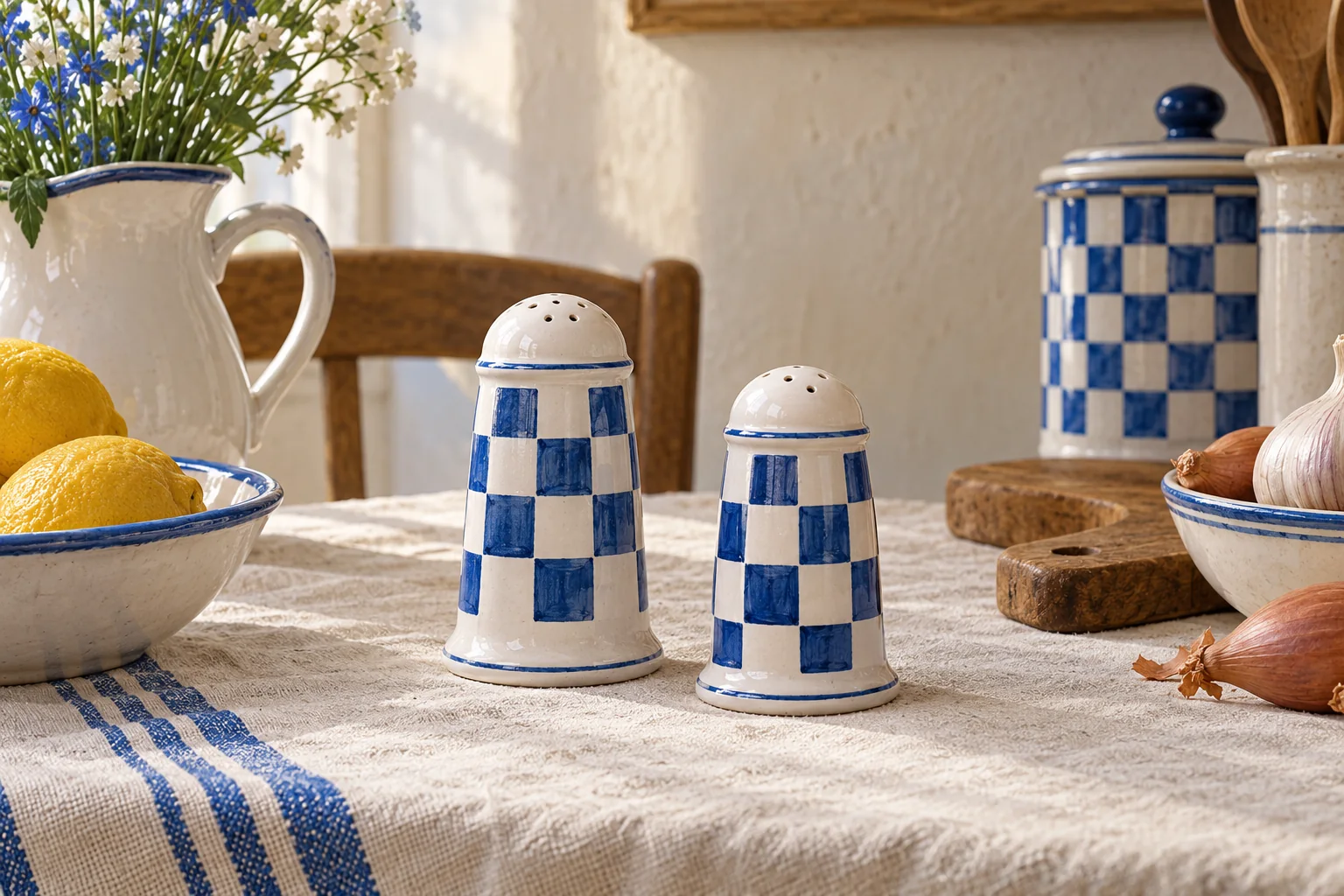
Lustucru salt and pepper shakers bring together French kitchen design, advertising imagery and the appeal of small collectible ceramics. Before calling a pair Art Deco, separate three questions: what the objects are, what connects them with Lustucru, and what evidence supports their date. A blue-and-white pattern or a seller's title cannot answer all three. This guide explains how to inspect a pair, document its marks and condition, and search for a missing companion without turning an old listing into a claim of present-day stock.
Start with the practical guide ↓
What connects a ceramic shaker with Lustucru?
The connection needs evidence on or about the specific object. It may involve a recorded inscription, a documented advertising design or a reliable catalogue attribution. A checkerboard pattern is a useful visual lead, but a common pattern does not identify a brand on its own.
Lustucru's anniversary material credits illustrator Synave with its familiar blue checkerboard. That source supports the history of the brand's visual identity. It does not date every ceramic object using similar decoration, name its pottery manufacturer or establish that a particular shaker was issued as a promotion.
Keep the brand and the maker separate in your notes. A food brand associated with an object is not necessarily the company that manufactured its ceramic body. Photograph the underside, any lettering and the complete figure or shape. Record the exact spelling rather than normalizing an unclear inscription.
A historical auction result also records a Lustucru-associated group including a pitcher and condiment pieces. It confirms that such objects appear in the collecting market, but its description is too limited to attribute every similar pair or provide a reliable date for yours.
Are Lustucru shakers automatically Art Deco?
No. Art Deco is a proposed stylistic or historical classification that needs support for the individual model. An object can be described as vintage, associated with an old brand and decorated geometrically without a documented interwar manufacture date.
The previous page address includes “art-deco-lustucru,” so this guide keeps that subject and explains the identification problem. It does not convert the wording of the URL into proof. No manufacturer, exact production year or original retail price is assigned to an unseen pair.
Seek a dated catalogue, advertisement or museum record that shows the same shape and decoration. Compare more than the front: the base, refill opening, molded details and position of the perforations may help distinguish models. A similar object with different proportions is a comparison, not a confirmed match.
This is the same distinction explored in the guide to dating and identifying Daum Nancy glass. A recognizable name can focus research, but the object's construction and documented model history must support the attribution.
“Two ceramic shakers with blue-and-white checked decoration; maker and date unconfirmed” is a useful starting record. Add a brand or date only when the evidence supports it.
How do you check whether two shakers belong together?
Place the objects beside each other and compare their overall relationship. A designed pair does not have to be identical, but its differences should make sense for the model. Ask for the two pieces in one photograph under the same light before comparing color.
| Detail | Record for both pieces | Why it matters |
|---|---|---|
| Dimensions | Height, width and base diameter | Helps distinguish related models and mismatched sizes |
| Decoration | Pattern, lettering and color | Allows a direct comparison under the same light |
| Underside | Marks, refill opening and stopper | May clarify manufacture and completeness |
| Perforations | Number, arrangement and condition | Helps compare models; does not universally identify salt or pepper |
| Surface | Chips, cracks, staining and repairs | Separates the condition of each component |
Check projections and thin edges carefully, especially on figural models. Ask where any restoration is located and whether overpainting covers part of the decoration. A missing stopper is different from a cracked body; a condition report should distinguish the two.
Do not use hole count as a universal rule for identifying salt and pepper. Practices and designs differ. Unless a model has explicit lettering or reliable documentation, describe the perforations and keep the functional assignment tentative.
Should vintage shakers be used on the table?
A historical table function does not establish present-day food-contact suitability. A photograph of a clean glaze cannot show the material's composition or the effect of an old repair. Where suitability is unknown, display the shakers and use modern food-safe containers for seasoning.
Keep the original pair together on a stable surface where small pieces will not be knocked against heavier ceramics. Avoid placing an uncertain repaired area under stress. Do not immerse an object with unidentified decoration, a damaged surface or an old repair before obtaining advice appropriate to its materials.
For a kitchen arrangement, measure the shelf's usable depth and clearance before buying. Record the footprint of the pair, not just the diameter of one shaker. Leave enough room to lift a piece without catching a projecting handle or striking another object.
The component-by-component approach is also useful for glass inkwells and vintage desk stands. A missing cover, replacement fitting or repaired base can change how an object should be handled even when the overall silhouette looks complete.
How can you find a missing companion or a related piece?
Prepare a short identification file before searching: front and back photographs, underside and mark, exact measurements, decoration details and a description of the missing part. A measurement in both centimeters and inches makes an overseas enquiry easier to compare. Use the same measurement points for each candidate.
For tableware searches, Lo-Cantou's missing-piece service describes a process in which scope and fees are agreed before commitment. Ask whether your shaker request fits that service. The presence of the service does not promise a match, a fixed price or an immediate result.
Explore its French vintage ceramics and faience collection guide for related vocabulary. Confirm the exact object, condition and availability directly; illustrative collection pictures are not inventory photographs.
To place these kitchen objects in a wider design story, compare Chrysler Airflow and the Art Deco idea of motion. A car and a shaker are very different objects, yet both invite questions about the relationship between design, public recognition and commercial identity. Keep that comparison interpretive rather than using it to date the ceramics.
Questions and answers
Does blue-and-white checkerboard decoration prove a Lustucru origin?
No. The brand documents its checkerboard identity, but a similar pattern on a ceramic object does not establish origin by itself. Look for a readable inscription, reliable model reference or documented provenance. Keep the brand association separate from the pottery manufacturer and from the proposed production date.
How can I tell whether a salt and pepper pair is complete?
Compare both pieces with a documented example of the same model, including the underside, openings, stoppers and any detachable components. Ask the seller to list missing or replaced parts. A pair can look complete from the front while lacking closures, having a repaired projection or combining different production variants.
Can vintage ceramic shakers safely hold salt and pepper?
Their original function does not prove present-day suitability for food contact. Without reliable information about the glaze, condition and repairs, appearance is insufficient. Keep an uncertain pair for display and use modern containers documented for food use. Seek advice specific to the object before returning it to service.
Can Lo-Cantou find the matching shaker for my set?
Lo-Cantou offers a missing-piece enquiry service for cutlery and tableware, but a particular shaker search must be agreed with the atelier. Supply photographs, marks and measurements first. Confirm the scope, fees and acceptance criteria before committing; the existence of the service does not guarantee a matching piece.